Showing posts with label anti-social behaviour. Show all posts

Wednesday, 8 August 2012

Why Punish Those Who Arrest Crime?

Greetings from an Olympic Borough. I'm writing this as the curtain comes down on the Olympic football events played here in Trafford as part of London 2012. OK, maybe it should have been Team GB playing Brazil tonight but insider knowledge (and a quick glance at our track record) suggested that penalties were always going to be a struggle. Quite a few local lads were known to have benefited from free Olympic balls as wayward shots evaded the fence around their training ground in Partington. It didn't bode well.


Shouldn't hard work and success be rewarded?
Even so, it's been a great games and unlike London, there's evidence that tourist numbers are up in the North West, so there's been an economic and morale boost from the Olympic goldrush. I learned of more good news today. All crime in Trafford is down 14.1% compared with this time last year - and no, that's not a quirk from the "riot effect" from last year as Trafford saw only the merest ripple from those troubles. As if that wasn't enough, instances of anti-social behaviour have dropped by a staggering 30%. So what's been going on?

Simply put, some cracking partnership work. Great links between different teams from the police, council and landlords; getting tough on crime and criminals and an increase in preventative initiatives such as our CleanStart programme which has slashed recidivism among Trafford's persistent and prolific offenders. Building on that partnership work we are now moving to co-located teams, co-ordinated intelligence and collaborative leadership. Whisper it quietly, but might this just be a bit of public service redesign that is actually delivering results?

So in a climate where "payment by results" is a favourite Government method to incentivise improvement, it is a little perverse that these outstanding results may have the paradoxical effect of punishment not reward. We all know that police numbers will have to reduce as austerity bites and that may jeopardise some of the gains that we have made. But the truly curious thing I learned today is that precisely because Trafford's crime stats are so impressive we may face a disproportionately large cut. That just seems bizarre. I hope the Police Commissioner candidates in November's elections are reading and taking note. 

What do you think? Should we encourage the progress that's been made, or is it just a harsh reality of the times we live in?

Friday, 30 September 2011

Basics: How To Beat Anti-Social Behaviour

Back to basics (although it should read ASB)
One of the enjoyable problems of writing this blog is that the subject matter for posts comes thick and fast, consequently choosing what to blog about can mean choosing what to miss out.

It seems that rarely a week goes by without housing hitting the headlines – as it did this week when Ed Miliband asked whether community-minded residents should get priority when it came to housing. Aside from reacting to the latest news, there’s the multitude of intriguing issues at work in the sector – ranging from innovation to responsibility – all of which could probably be the subject of a blog in their own right.

However, one thing I want to focus on more are some of the main issues that THT as an organisation are confronted by. As well as that I’d like to give readers an up-to-date view of the services we’re responsible for. So over the next couple of months there will be a series of guest posts from people within THT looking at these “basic” topics. First up, Tony Lowry, Assistant Director of Neighbourhoods, on how we are confronting the ever-present issue of anti-social behaviour.

                                                                      *********

In a recent blog Matthew wrote about the importance of getting feedback from tenants. One topic that they have always been very vocal and emphatic about is anti-social behaviour. Anti-social behaviour is one of the main causes for concern from tenants, and if we are to achieve our mission of being at the heart of our communities then we have to take it as seriously as they do. You can read more about our approach to the topic here, but the simplest thing to say is that we understand precisely how this issue can ruin the lives of individuals, destroy families and ultimately tear apart communities unless it is dealt with promptly and properly.

Despite the doom and gloom that usually surrounds the topic, over the last few years there has been a lot of work done on how anti-social behaviour is approached by organisations like THT. That effort has laid out an intriguing – and exciting – new approach, which has resulted in some real success. Statistics never tell the full story and I wouldn’t like to say that we had the problem beaten but the following make for good reading:
  • We get 250 cases of anti-social behaviour a year. This is less than similar organisations working in similar areas. We feel this has much to do with the quality of our work to prevent anti-social behaviour in the first place.
  • We know tenants want us to work towards solutions quickly. Consequently, we monitor the time taken on every case and we now have only nine cases open more than nine months. 18 months ago this was 36 cases.
  • Every person reporting anti-social behaviour gets at least a monthly update.
  • We have just had our best month ever with the number of anti-social behaviour cases successfully resolved in agreement with the person who reported the case.
One very interesting study which has helped shape organisations' response to anti-social behaviour was undertaken in nearby Salford. One of the surprising things that it revealed was that only a small number of families were responsible for most of the anti-social behaviour experienced in the area. These were not typical families either – they were living chaotic lifestyles characterised by debt, addiction, domestic violence and long-term benefit dependency.

To get a fuller picture, all of the contacts and interventions from the various agencies were mapped out and costed for just one of these families. The cost amounted to £160k per year! It would have been cheaper to put a Police Officer on their doorstep all year round! The key thing that the study revealed was that all of this intervention was reactive and, therefore, unplanned. This incredible amount of money was spent fighting fires. Clearly, this was not the right approach and led to a re-think in how to address the problem. The conclusion was that organisations and agencies had to learn to combine their resources and budgets to change the approach so that now, virtually all of the contacts and interventions are planned.

The financial implications of taking this proactive stance and helping this family out in a more rational way, is that it now only costs £120k per year, saving the tax-payer £40k per year. If you factor in the tax now being paid by the two members of the family who are now in work, the overall savings are more like £60k. Perhaps more importantly still, this positive approach is more effective and means that rather than spending the money on clearing up and punishing anti-social behaviour, we can help prevent families from committing it in the first place.

Imagine the implications if it’s not just one family, but twenty, or thirty getting the benefit of this shift in approach. The overall cash gain to the tax payer is potentially in the millions. This isn’t money that will come through to organisations like THT, but if we are undertaking this work and standing by our values to make communities stronger, then that means we have to protect those who are about to drop off the edge. If we can help a family with a few problems, or those intent on bringing full-blown chaos to an area - then we, the families and our communities all win.

Impressively, the recent trend of anti-social behaviour reducing has continued despite the cuts impacting on youth services and police numbers. The key to making this work in the future is to make real and fundamental changes in how services work together. It’s about stating what needs to get done, how it will be done and who is responsible for getting it done. If we are to carry on these improvements and continue acting on the concerns of our tenants then these partnerships are the key to unlocking the problem, because ultimately we believe that we can beat anti-social behaviour.

Friday, 12 August 2011

The Right Response To Rioters

What a week. What would have been a normally busy week, suddenly morphed into an abnormally busy week with the development of the London riots, which spread across to Manchester and Salford on Tuesday night. As planned we kept well linked in to Trafford Council's Emergency Planning Team and convened an emergency meeting to discuss and publish our response to the riots. The accepted "wisdom" that social housing tenants are all rioters-in-waiting is, of course, facile nonsense, but we do know that some Trafford residents (not necessarily our tenants) were involved, even though the rioting was all outside our Borough.
Greater Manchester Police's Most Wanted from their Flickr profile

Consequently, we had to have a clear view of what approach we were going to take. The decision was actually relatively straight-forward. We have stringent anti-social behaviour policies in place and it’s clear that this week's rioting is about as anti-social as it gets. So any of our tenants who were rioting should have realised they potentially ran the risk of losing their home. Quite a price to pay for some free trainers.

It’s a rather throwaway phrase “losing your home”, which somehow makes it seem like an act of carelessness, but like all housing providers, we see eviction as the absolute last resort. After all, it simply creates a different sort of housing problem that then needs solving. As I watched news of the riots breaking across Twitter one thing that struck me is that there have been two groups faced with losing their homes this week: the vandals and the victims. It’s been tragic to watch the news footage of the innocent victims coming to terms with losing their businesses and their homes.

It was Jacque Allen, who is now the Executive Director at Dales Housing who I first heard refer to the housing sector as the fourth emergency service. When we see real-life dramas like the riots played out on TV, the truth of this statement doesn’t always become apparent. Largely, it’s the frontline services that we see who deal with the immediate impact of an emergency. However, it's when the fires have been put out, the ambulances have taken the injured to hospital and the police have re-established control of the streets that the lost homes quickly become a major concern.

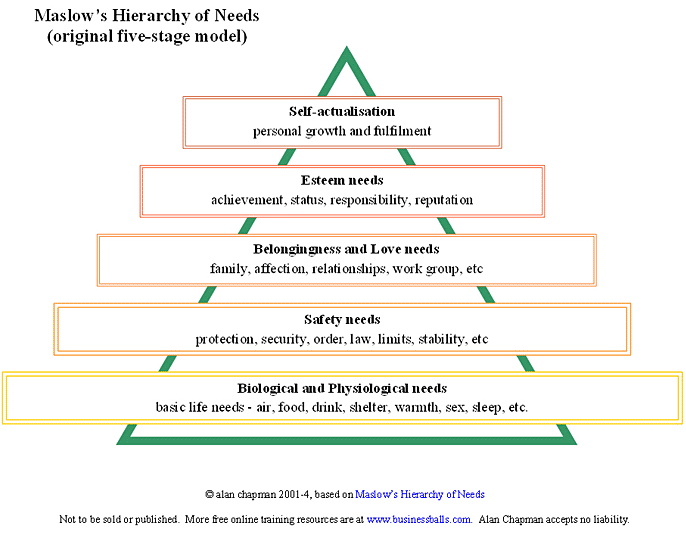
I’ve referenced Abraham Maslow’s hierarchy of needs before, but a cursory look is all that's needed to see that shelter is one of the fundamental human needs and every bit as essential as air, food, sleep and drink. Remove any of those fundamentals and things start to become perilous very quickly. So, who do you reach out to when suddenly the house that you took for granted for so many years is suddenly taken away from you?

For the last six years THT have run the Homelessness and Temporary Accommodation services for Trafford Metropolitan Borough Council and our staff have been the ones responsible for hearing people’s tragic stories and healing the situations. Given the occasionally turbulent past of the North West, we have been fortunate that in those six years there have been no major incidents that have really put the excellent training of the service to the test. At times like these when riots spread through the country, these sort of services stand on high alert.

In many ways it’s a real shame that this team's work is done in the darkness and not seen by the television cameras or wider society. They should probably have a similar sort of uniform or identifying factor to mark them out as heroes, just like the other emergency services. You can probably tell, but I’m endlessly proud of their work and extremely pleased to know that the values that are embedded in everything THT does, are also at work in that team too. I would like to say a public and personal thank-you for their work and achievements both in preventing and addressing homelessness, and in giving personal, practical and emotional support to homeless people and their families as they become resettled.

Source
The work of this team will shortly be transferred to Salford Council from September 2nd and I wish them all the best, especially as it seems likely that the handover will happen at such a fraught and turbulent time. I hope that they never have to prove their training at Salford either.

It seems wrong to strike such a depressing note and not at least introduce a silver lining. If you are on Twitter then have a look at the #riotcleanup hashtag, because it goes some way to restoring your faith in human (and British) nature. The @riotcleanup account has co-ordinated the clean-up efforts of ordinary members of the public who want to scrub away the dirty work of the rioters. The riotcleanup account jumped to 87k followers in a matter of hours and its numbers are growing by the second. It seems that for every rioter there are 20 more people who have been moved to help support the work of the housing sector and help the victims put their lives back together. There are even efforts afoot to raise money for individualsdamaged by the riots.

As communities begin the work of repairing their homes and businesses, it’s essential that we keep these more positive facts in mind, as well as the many incredible things done by the younger generation, so that we don’t write-off an entire generation as simply vandals in hoods.