Friday, 20 January 2017

New supply not enough to solve housing crisis

I spent quite a bit of the recent holiday season travelling, and with eight flights in 11 days it’s perhaps not surprising that it’s an airport metaphor that has come to mind as I write this article.

Housing associations seemed to have been hanging around in the departure lounge for much of the last parliament – our flight never being called – while homeowners and developers took the fast-track queue to their gates.

But towards the end of last year, we were called up – given our boarding passes, if you like. The encouraging words of the new government turned into some extra money in the Autumn Statement, and while we may not yet be on the plane, we’re clearly on the bus and heading out across the tarmac. Our destination: solving the housing crisis. A genuinely positive and exciting opportunity.

“We need a housing system that works for everyone.”

Nevertheless, I have an apprehension. I’m not sure yet that we all agree on what a solution looks like. There’s a lot of talk about building new homes and of course that has to happen. Government has committed funds and we must now respond with delivery.

Here in Manchester, the long-awaited city region Spatial Framework was finally published before Christmas, and it has already become a political lightning-conductor for the elected mayoral candidates as well as a focus of public protest and intense debate. We’ve had our say, and the National Housing Federation is also looking to lobby those standing for mayor to ensure that whoever is elected truly is a mayor for housing.

The argument that we need to double the output of new homes is won. The conversations now are about where we put them, what type of stock they are, and what infrastructure, services and amenities we need to surround them to ensure we create sustainable, safe and healthy communities.

At Trafford Housing Trust, with our joint venture with L&Q and the refinancing we have just completed, the rate at which we will build those new homes will increase from around 200 a year to 2,000 over the next four years. Many other housing associations are doing the same: stretching balance sheets, leveraging grant and using profits from market-facing homes to create more affordable homes without subsidy.

So we are on the way to increasing supply – and we would be even further if the forthcoming White Paper proposed some kind of “use it or lose it” on landholders and speculators. But for me, while more homes are a necessary part of the solution, we should not be persuaded by the development lobby that, on its own, this is sufficient. Other things must also be addressed.

First, we need a housing system that works for everyone, not just for aspirant families with steady incomes. Look hard enough, and from rough sleepers to sofa surfers, from families in bed and breakfasts to single people discharged from prison, from those with mental health needs to those leaving care, we see around us a damaged system that harms the most vulnerable.

Second, we need a housing system that is joined properly to the health and social care system. Only then will delayed transfers of care from overfull hospitals become a thing of the past. That is assuming the imposition of the Local Housing Allowance cap – the unintended consequences of which Clare Tickell spelled out so well – does not derail that joining up before it can get going.

And these things can only rightly be determined locally. So the third part of solving the crisis is more devolution, more freedom and more flexibility for local areas to determine their own future – and in areas that have been off limits up until now.

How different things would be if housing providers up and down the country could show to the government that freedom to set our own rents will lead to a reduced benefit bill for government and how freedom to select our own tenants, and the tenancy products they receive, will extend affordable housing solutions to those left behind in the current system, rather than erode local authorities’ ability to meet their statutory duty for homeless families.

So as we get on our plane and head off to solve the crisis, let’s remember that increasing supply – the first flight – is just one stop on our travels.

The onward flights will be into unknown territories, where government interests – and hence their financial support – do not exist and where the terrain may be difficult or even hostile. But solving the crisis requires us to go there and not sit comfortably in the land of new supply.


Wednesday, 23 December 2015

That time of year

Anyone else noticed that there just aren’t enough hours in the day (or days in the week, weeks in the year etc)?  It’s the same with money – there’s just not enough to go round.  So I don’t know about you, but I find myself entering the traditional season of goodwill and time of new resolve pretty burned out and feeling more than a bit broke (metaphorically of course).  How will I have come out of it – or more pertinently how will the social housing world have come out of it - by the end of 2016?

As my brief for this blog was that it might be published before or after the festive season, you can view the following list both as what I want for Christmas and, because I’m sure it can’t all happen by then, my New Year’s resolutions.  But if by the year end we had all worked together to make a few simple1 things happen – wouldn’t the world look just a little bit better?


  1. We knew our customers – not just through their data, but through our shared humanity; that their hopes were our hopes;  that we provided a safety net when they are at their most vulnerable and that for those experiencing poverty we stood alongside them to help them escape. Something that would have to involve…
  2. …the replacement of the unworkable and catastrophic cap at LHA levels on rents with something developed between government and the sector which provides a different method of capping the Government’s exposure on benefit payments…
  3. …a cap that would be a good thing, because then the sector could be free to set rents at the levels we feel best suit our market and our purpose, not have government use rent levels as a proxy for controlling benefits.  And we might just find that then, as some went up, others would come down, alleviating hardship for many who find the term affordable rent an oxymoron.
  4. Hospitals with no patients awaiting suitable homes to be discharged to, because housing providers’ pivotal role in resettlement and re-ablement has finally been recognised.  You never know, we might even have Health, Housing and Social Care working together as some kind of trinity, as opposed to being, like Ancient Gaul, divided into three parts, none of which speak the same language.
  5. A strategy for land supply that keeps pace with the growing number of households and an obligation on the owners of that land to develop it in a reasonable timeframe or face financial penalty.  Surely 2016 should see the end to speculative land hoarding?
  6. The meaningful application of the principles of the Social Value Act to the sector’s supply chain so that it is made up of social businesses who share our passion and our values.  I’m particularly looking forward to the point when that applies to somebody in the IT supply chain because…
  7. ….2016 has to be the year when we get the sector out of the technology dark ages, and hook ourselves to IT suppliers who understand the meaning of the apparently difficult concepts of “customer”, “transformation” and “now”.
  8. An end to award dinners.  Nuff said I think, don’t you?
  9. And last on my list of wishes, could we have by the end of 2016 a sector that fully accepts a “profit for purpose” future, confident of our independence from Government, assertive of our right to be heard, proud of the profits we create, and unstinting in our commitment to use those profits in the service of those in greatest need?
Whether you’re suffering from a pre-Christmas burnout or a post New Year hangover, I hope at least one of these thoughts has cheered you up.

Notes
  1.  I lied about the simple.
Wishing you all a Very Merry Christmas and a Happy, Healthy and Prosperous New Year for 2016

Wednesday, 19 August 2015

False dichotomy

You know that familiar part of radio interviews where some musician is posed contradictory alternatives and asked to choose quickly between them?  “Meat or fish?”; “United or City?”; “books or movies?”.  

picture showing one way signs pointing both left and right
Only two choices?
Of course, the answers are just what passes for entertainment, and while everyone knows that the real world is more complex, nobody is going to be amused by an answer that goes “Well, I love a good novel on a wet Sunday afternoon, but Orange Wednesday’s were fabulous and the cinema seats are so comfortable these days, so can I have both please?”

Celebrities have learned to play the game; it's called “False Dichotomy”.   And so it seems have we. You may have noticed that what passes for a row has broken out in the social housing world. 
Positions are being taken – with reported comments from Genesis and Aster on the one hand and SHOUT supporters on the other; views are being aired and shared; perhaps even destinies are being forged.

Strident headlines proclaiming that market-facing solutions are the only solutions are followed by equally vehement commitments to the values of social housing.  Of course, these respective positions stem from viewing our world through the always distorted lens of our binary-based political system.
Now don’t get me wrong, political parties are very important, especially ones in Government with every prospect of a decade of power.  So, practically, embracing their new agenda is a necessary step to secure organisational survival into the future.

A necessary step, yes.  Because Government holds, and can therefore withdraw, our licence to operate.

However, if the government lens is the only one through which we seek to develop our organisational strategy, then we are in our own minds already public bodies, just as, perhaps, we will be in the eyes of the Office for National Statistics once details of the Right to Buy are known.

And doing what is necessary is not the same as doing what is sufficient and right to develop a clear and lasting strategic direction.   Good strategy is derived from multiple perspectives and has a complexity and nuance that neither plays well into any political narrative nor is easy to portray clearly in the full glare of modern media – social or otherwise.

At Trafford Housing Trust we know we can and must up our game in the media if our great work is to be recognised and valued.

More importantly we have to have the right strategy to work to, one that balances the conflicting interests of current customers and those of would be customers; of those who view social housing as a springboard to something else, and those for whom it is a vital safety net; of those who want the right to buy their own social home and those who want to leave adequate social provision for the next generation. 

We know our strategy has to change if it is to remain relevant.  The questions we are asking are: how should it honour our heritage, respect our own values, acknowledge our context, articulate our charitable intent and paint a compelling vision of the future.  We know these can’t be answered satisfactorily by the false dichotomy posed by “social housing or market housing?”
.  
Let’s all stop pretending that it can and move towards a positive debate about the essential part for both within any sustainable ‘one nation’ approach to housing in the UK.  


Monday, 22 June 2015

Living Rent - only half an answer

There is much to commend the work that Savills, the National Housing Federation and JRF have put into devising a better rent model than the hotchpotch nonsense we have now of Affordable Rent (AR) and Social Rent (SR). 


Without doubt, any rent regime that relates to the market value of property (as both AR and SR do in their different ways) when the intended occupant, by definition, is somebody unable to compete in the market, is bound to be flawed. So the reliance on a proportion of income alone as the key influencer of rent charged is a logical and progressive move.
Whether it is also an ambitious one is more questionable.  Its title promises the assumption challenging approach of the “Living Wage” campaign, but it feels more like a shift along the existing approach rather than a new approach entirely.  With the new circumstances that austerity, lack of funds for new supply and welfare reform seem to demand, I wonder if it goes far enough.

Firstly, while expressly stated as not being obligatory, it gives housing associations an "undemanding" methodology to establish their own rent levels.  By default, I suspect many will choose to use it.  But in so doing they are abrogating to others the essential task of ensuring that the price point they charge is specific to the product they provide to their customer. Despite the heavy-handed years of "one best way" type regulation, not all housing associations provide the same quality product or the same quality service. Differentiation across the sector on these things is set to increase further in the absence of the audit commission enforcement and with consumer regulation predicated only on a no “serious detriment” test. Suggesting a standard methodology across whole geographies runs counter to the direction the sector is taking and will inhibit its ability to demonstrate real value to customers.

Secondly, it relies on a continuation of the notion of a "rent envelope", enshrining yet again a legitimacy for Government to control rent; something that no longer exists now rent levels and benefit levels have been decoupled for many customers. Government's interest is in controlling benefits, and that is exactly how the local housing allowance system works in the private sector. PRS landlords are free to charge whatever rent they choose and make a series of calculations in order to determine what that should be. The time has come for housing associations to be treated in the same way - for maximum benefit levels to somehow be prescribed by government - but for freedom over actual rent levels to rest with Boards of what are after all independent organisations.
We are a living wage employer logo

The "Living Wage" works - and at THT we are fully signed up members of the campaign, even paying it to staff within our domiciliary care business -  by setting a floor, below which nobody's pay falls. Mature employers then decide their own pay and reward structures around that baseline.

The Living Rent will operate differently, becoming a target not a starting point. Are housing associations so immature that we need our hands to be held in this way?  Or is the fear that free to charge rents at levels of their choice, some would forget their values and tighten the screw further on the already poor. Either way, it's poor governance at the root of the problem. Organisations with good governance, based on a sound set of anti-poverty values, must have the freedom to set their own rents and be held to account for the rent choices they make
.


Monday, 20 April 2015

The Singularity

You might not have heard of The Singularity - nor had I until I happened across a Radio 4 programme that explained all.  It’s got a cracking little website all of its own that you can find here: http://thesingularityprogramme.tumblr.com/  

The Singularity - when AI overtakes human intelligence
So why is The Singularity important for #ukhousing? Well, it marks the point in time when, according to experts, Artificial Intelligence will overtake human intelligence and when that happens, everything changes.  Far off?  Science fiction?  Maybe, but there are some very smart people at Google, IBM and elsewhere who are absolutely convinced that super-intelligence that exceeds that of the human is inevitable, because of the exponential rate of increase in computing power.  


BigData & FabLab

At a time when digital headlines in #ukhousing seem characterised only by negativity to tenant tablets and drones and when much of the other digital stuff, such as BigData and the growing FabLab movement is passing us by, it’s not a popular thing to say that digital transformation is a necessary part of any successful housing association business model.  But being unpopular doesn't mean it’s wrong!  And that's not incremental change, but massive, continuous transformational change.  How else are we going to keep pace with the expectations of an increasingly tech-savvy group of customers?  How else will we will be able to bring medical and social care advances to the old, sick and vulnerable who we house?  How else will we help equip tenants for a jobs market in which entry-level jobs have been fully automated?  

If you are more concerned with the present than the future; if regulatory pressure on value for money is the monkey you need to get off your back; if falling rent collection because of welfare reform is threatening your business model; and if the rising cost of bricks and the labour to turn them into buildings is curtailing your ability to develop new homes, the answer still lies in transformation.  In a different world, where no Government is coming over the hill to rescue associations; where tenants are simply going to get more demanding and discerning before they pay their rent; doing what we’ve always done isn’t going to cut it. 

Some of these thoughts and ideas will be topic of the session in London next month where HACT and the northern housing consortium are coming together to discuss “Next Generation Solutions”.  You can find the full programme at http://www.hact.org.uk/events/next-generation-solutions-housing-transformation-and-innovation and I hope to see you there.


Oh, and in case you wondered, Ray Kurzweil Director of Engineering at Google who is working on machine intelligence and the use of natural language to drive computers and the man credited with coining the concept of the Singularity, projects that it occurs sometime between 2029 and 2045.  Will you be ready?  Will your organisation be ready?


Wednesday, 12 June 2013

Three Reasons A Freemium Model Would Never Work In Housing

It’s been just over a fortnight now since I published a blog talking about the possibility of how a freemium model would work within the world of housing associations. Judging from the discussion it generated on my Twitter feed it would appear that the housing sector is perhaps not ready for an open and real discussion about how we might benefit from different business models. Sadly though, I think that unless the sector actively chooses this conversation then we will ultimately find ourselves losing control of the discussion and having innovation imposed upon us. An even scarier thought is that acquiescence might hasten the return of regulation, thus strangling our ability to innovate.
 
In short, the way I see a freemium model working is quite simple. Based on a similar principle to Dot Dot Dot’s approach we could use some of the homes that we currently have empty within our stock to provide a first step home for people who were unable to pay. These people might have been recently released from jail, they might be people with poor credit ratings, they might be homeless. They would be able to live in the property in return for their guardianship of it during maybe a six month initial period. Their occupation might even be tied to a level of community volunteering. However, they would live in the house rent free. After the initial period we could then look at them graduating to other homes within our stock, or onwards into the private market.
 
In discussions on this topic since I published the blog I’ve found three main objections to the freemium idea.

1) It would provoke community resistance

There’s no doubt that it’s a tough sell to the people who aren't getting free houses. How do you respond to people within the same community, aggrieved that someone in their midst is getting free rent? Is there perhaps a way to engineer an increase in supply of empty homes beyond a housing association's own void portfolio that could be used in this way so that they too could be offered the same deal? It would need to be in a property that had the basics but in November 2012, 710,000 empty homes were empty in England of which 259,000 were long-term empty (meaning they have been empty for more than six months).
 
2) People should be able to access more permanent housing solutions, not rely on temporary ones

Yes, they should, but they can't. And for the many currently excluded from permanent social or private rented housing this solution would be useful. These are the people who would struggle to either afford or arrange a conventional letting procedure. These are the people who are falling through the cracks currently – the idea of giving them a platform on which they could build, while developing a further stream of potential customers for us in the future has to be an attractive thought.
 
3) You can’t give houses away for free

There’s an argument that’s hard to disagree with - that organisations don’t generally do well by giving away their main product for free. That’s true and the freemium approach wouldn’t work for all the stock in a housing association’s portfolio. However, while we have a number of properties that remain empty, no matter what we do, they aren't generating an income. They can though be used in a way that reduces costs and which generates a non-financial return. Looked at in a social value way, the economics are not so mad.
 
Innovation around the use of empty homes has a long tradition within the sector - short-life housing was once officially recognised (and funded) through the Housing Corporation; but it's always been at the margin. Does the severity of the current housing shortage mean it now deserves its place within the mainstream?


This post was first published on Inside Housing

Wednesday, 12 December 2012

It's Cold, It's Christmas And It's Callous

Sometimes there are things you have to do that you know you are not going to enjoy. Like reading the latest DWP Impact Assessment for Universal Credit. I read it because I thought it might shed some light on the impact of Universal Credit - after all, the clue is in the title if you look closely enough. Now, with the wet towel unwrapped from around my head and the smelling salts fading into the atmosphere some light is dawning (literally as I write this).

The Assessment itself is a well crafted piece of work - in my quasi-civil service days at the start of my career I would have been proud to have written such a precise piece. Of course, it's not exactly flowing prose but the facts are set out clearly, as is the logic used to produce them. So far, so good. But, there are a number of "buts".

The biggest is that if the headline of more benefit take up, less fraud and more overall cost to the Treasury is true, how come it doesn't feel like that for many households? Some of the answer lies in how averages and totals mask some pretty dramatic cuts - within that headline of "good" news is buried the detail that 1.3 million households will see weekly income drop by more than £100. Some comes from the fact that only financial value is assessed with no attempt to "impact assess" in any social value sense.

Then there's the related fact that DWP appear to have written it from a "producer" perspective. What this policy means for the DWP and the Treasury can be discerned, but for individuals - no chance. It's a real shame that the scope of the Social Value Act doesn't impose a requirement that policy making - as well as contract making - should be subject to a wider test of social and not just economic measurement. How in 2012, with everything that has happened in recent years across the world, can we choose such a narrow definition of success or failure?

But for me the biggest failing of the Impact Assessment is its absence of humanity. As this policy plays out, we must ensure that the real impact is truthfully portrayed. Yes, there will be heartwarming cases where the benefit changes provide a motivation for self-improvement of the kind MPs expect to see. We should not be afraid to report those - they matter for the individuals and society as a whole. But we also need to report factually how for a family losing £300 from their weekly benefit their choices are now between food and heating, we need to show how respiratory illnesses have increased and how child nutrition has suffered.

These human stories will play out across the country in the years to come as the callousness of this policy - encouraging people into work that for many just doesn't exist - becomes apparent. Comms teams across #ukhousing have got a job to do next year.

Wednesday, 5 December 2012

My Review Of The Northern Housing Summit 2012

The Northern Housing Summit organised last week by the Northern Housing Consortium #NHCsummit on Twitter was a good do (there's a good Storify from the NHC events team which rounds up a lot of the coverage). Perhaps there was a little too much economic doom and gloom on the first day – but as most commentators don’t think that the Chancellor’s Autumn Statement today will give much cause for jubilation, perhaps those predicting 20 years of hardship have actually got it right. Still, amongst all that doom and gloom there were some bright spots.

A highlight for me was recognition for our ambitious apprentices project as the overall winner of the NHC’s Silver Screen competition, which this year focused on projects working with young people. I’m really proud that this excellent project (more information here) got the recognition it deserved, that the inspired Vicki Duncan got the credit for coming up with the idea and that we were able to take all seven of the fabulous apprentices we employed from the project to the awards dinner.

Among the other events, three really stood out for me. Louise Casey gave a thought-provoking interview about her work as ASB Czarina and she challenged the audience about why, as landlords, we didn’t do more with the few who cause such vile nuisance in the midst of local communities. The phrase “what we permit we promote” sprang to mind – something that at THT we have used regularly to guide the way we deal with staff inside the organisation. But does that extend to our dealings with tenants? My conclusion is that it doesn’t – with them we don’t always “tell it like it is” and make sure that tenants causing real trouble for their neighbours really do understand the urgent need to change their ways.

Also in an interview-style setting, Julia Unwin talked with understanding and compassion about the real statistics behind welfare reform and that how as housing providers we needed to get much closer to individual families in order to understand and help alleviate the challenges that they face. The sad fact is that we are far more likely to know the full details about the physical condition of the fabric of their home, than we do of the social fabric that binds the family that lives in it. How did we reach that stage – an understandable caution about collecting and using personal data and a regulatory regime that cared for process not outcome. Thankfully, the second no longer exists, and we need to do a lot to get over the first!

Finally, Sir David Henshaw was his usual provocative self, taking few prisoners in a wide-ranging review of attitudes in housing and public services. He didn’t see enough of housing organisations being led by their customers, he didn’t see enough innovation and he didn’t see enough engagement with other organisations across the public sector to make maximum use of our combined resources. Moderated with humour and including the NHC Summit equivalent of a pensioners tea-dance this was more thoughtful than that description might suggest – nonetheless, the message was unmistakeable.

When you have three people all telling you much the same thing – you are complacent about your customers – perhaps as a sector we need to listen very carefully to what they are saying. If welfare reform really does end up with rent being paid to tenants, suddenly, they could all become very price and service sensitive and being complacent about a customer who has to want to pay you your rent probably isn’t the most sensible strategy...

Wednesday, 28 November 2012

Are You Going To Disrupt Or Be Disrupted?

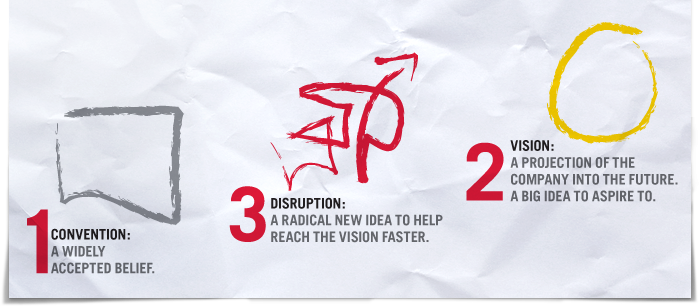
One of the most notable things about the housing sector is that right now everything is changing. If history has taught us one thing it's that at a time when everything changes there are people who win and people who lose. My conclusion is that those who are going to win are those who are prepared to be disruptive about the business models, about the technology and about the customer orientation that our sector has had in the past.


Let's take the business model first. Housing associations have traditionally had a "have and hold" business model. We own assets that are built using long-term debt raised from banks and grant gained from government. We then hold those assets for ever more using the rental income generated to repay the debt and cover the costs of management and maintenance.

There are some variants - there is an opportunity to increase profit by building housing for sale or shared-ownership and to subsequently recycle those profits to support less financially-viable housing for affordable rent. But the basic model remains as it is since the late 1980s when private finance was first introduced. With two of the three pillars on which that business model is based now gone - long-term debt from banks and significant levels of grant from government - it has to be questioned whether this business model can survive.

When it comes to technology the basics have remained unaltered for even longer. Most IT systems that are available to support housing associations are far better at recording transactions about an individual customer than recording their individual characteristics, hopes and aspirations. And how do these systems help when it comes to showing the impact of housing associations undoubtedly beneficial work on local communities - the whole social value agenda? The answer is that they are entirely inadequate. The technological changes required extend beyond the IT systems in our offices into the technology we use to communicate with our customers in our communities.

My top ten of technological innovations I'd like to see caused a few comments and I've been keeping a close watch on the emerging technologies to see what there is that might be relevant to our sector in the future. I'm not saying it is directly relevant but did you know that there is a project in America which is trying to use a 3D printer to create a gun? Clearly, it is a horrific prospect and it puts an onus on us all to find a more socially-useful application of this fantastic technology. If we want to disrupt, instead of being disrupted then we must look to the new technology and how it can help us achieve our aims, but do so in a relevant, ethical way.

And as for our customers, the disruption here will be obvious, as most of them are about to get the biggest wake-up call for a generation. We are about to witness welfare benefit reform sweep through a customer-base not used to having to think about the value-for-money of the home that they are renting. At the same time the "one best way" regime of the centralist Audit Commission, no longer exists. Finally, housing associations have freedom to respond to their customers in a way that they see best, rather than the way that Whitehall sees best. What they do with that freedom remains to be seen.

My take on all this - and it's one I hope to share with colleagues in the National Housing Federation soon - is that as a sector we are ripe for transformational disruption, it lingers over the sector as both a potent opportunity and a potential threat. What makes this all the more pressing is that if we don't do it ourselves, then there are lots of others waiting in the wings who would be more than happy to bring the disruption to us. 

Wednesday, 21 November 2012

So How Do We Actually #killwonga?

There’s a well-known philosophical conundrum: if a tree falls in an empty wood – does it make a noise? Well, I'm sorry to reveal to any navel-gazers out there who have been pondering this question for a while, but I can reveal that the answer is yes. The reason I can be so sure is that the tree falling is almost certainly heard by representatives from www.openwonga.com, a website that’s dedicated for people “to discover more about Wonga, the digital finance company.”

Essentially, www.openwonga.com are much like the sensitive outer strands of a spider’s web which when twanged by some hapless insect create vibrations which summon the spider. In this analogy though, the insects are really off-message mentions of the Wonga brand. You can try it on your own blogs and Twitter accounts. For all I know if you whisper Wonga five times into a mirror they might appear behind you. In my own case they got in touch after my last post to point out that actually,their customers don’t pay anything like the 4,212% representative APRs that they’ve been maligned with. 

Strangely they didn’t respond to my question of whether with £48.5m in profits they could charge substantially lower interest rates and still provide a return for shareholders. Or whether, they might like to enhance their brand with a bit of old-fashioned philanthropy towards the marginalised communities from which they make those profits. It seems that like the tree falling in the empty wood, some things are destined to go without an answer. And answers are most certainly needed - read some of the articles covering this topic if you need convincing.

As pointed out last time, #killwonga is not a vendetta against the company itself – and more of a rallying cry to the burgeoning partnerships between those of us who care about Civil-, Big-, Fair- or simply Our- Society [pick your own least offensive phrase] to look at ways that we could create an innovative and disruptive model that would challenge the Wongas of the world. Our values and our focus on social outcomes above distributable profits means we could be part of something that provided a far lower cost alternative for our communities. They wouldn’t then have to turn to private entities, who are duty-bound to make more and more money. 

This notion feels very much of the zeitgeist. Looking around you can see Bank of DaveMy Home FinanceGrameen Bank – it’s not just a general sense of dissatisfaction following the recession that is causing this. Now more than ever, people are looking at the business model of finance and wondering if it can’t be improved upon. Who knows, perhaps the Civil- Big- Fair- Our-Society thinking really will have an effect on our action. 

So how would the #killwonga project work? My personal preference would be to look at how the micro loans can assist investment and enterprise, rather than (just) trying to alleviate indebtedness. We are ideally placed as housing associations to see when our tenants are in a position to use the money in a way that would benefit them. What’s more we can also plug them into a network of business advice and support. And between us, we probably have some spare cash that would be well suited to a modest return in exchange for a managed risk.  

As I’ve mentioned before, the idea of being central to our communities can just as easily be achieved through the loan to start a business, as it can through building homes. And a fund, at a manageable rate of interest lent on the proviso that those using the funds also accessed business help, could be just the alternative needed for a group of people who have often been disenfranchised because they have poor credit ratings. 

There are people already doing this; #justfinance is the term coined by the Community Development Finance Association in its report earlier this year (you can find it and other really interesting stuff on the Social Finance site). If housing associations are serious about financial inclusion, and if there really is an enlightened self-interest for us that strengthens our business and strengthens our communities it requires that some new conversations to happen - doesn't it?

Wednesday, 14 November 2012

Kill Wonga: Or How Could Housing Associations Work With Community Organisers?

I might have mentioned previously that my time working on the National Housing Federation has come to an end. I hugely enjoyed the six years I spent with the organisation and I’m sure – in fact, I know – that my work with them is not done and dusted, more of which in a later blog. So, how does one fill the void left by the Fed? You might assume it’s badminton, cycling and the occasional documentary about glacial movement? Well, you’d be wrong – instead it’s off to another organisation who I feel encapsulates an aspect of housing I find fascinating, namely, the Housing Action Charitable Trust, or HACT.

There’s a variety of reasons why the work of HACT attracted me. Going back to my experience in housing in the 1970s and 80s, housing associations were very much "of" community. You only have to look at the organisations like Paddington Churches Housing Association (now Genesis Group for any youngsters reading) and its formation out of the North Kensington Amenity Trust to see that new housing organisations at that time were formed by community activists who wanted things to be different in their area. That’s the soul of housing that I first encountered in my impressionable mid-twenties, and it was a soul that appealed. If all you are doing in housing is putting one brick on another and standing back and saying, that’s a nice piece of Flemish Bond then that’s not the whole story. My passion for housing is that it’s about a sense of place and understanding why places work and why they don’t work. All of which leads me to HACT.

Thus far, I’ve not had a great deal to do but this week I went to a meeting where HACT people were out in force. It was the first meeting of its kind between housing associations and the 2012 version of community activists - the emerging community organiser movement. For those of you not familiar with what this is, look up www.locality.org.uk to see how it is playing out in the UK, or if you want to feel the real 1970's flavour, go to the works of Saul Alinsky (and as a short cut here are some of his most interesting quotes). There was a nervousness about the meeting. Community organisers are, ultimately, about the transfer of power to communities - instilling an urge to action from unlikely places. For many communities, housing associations are actually part of the power structure that needs to give things up. You can see the potential for conflict...

In practice, it worked extremely well - for those of us in the room, although I can though imagine a few housing association CEOs having apoplexy at the concepts! We found we had much more in common with each other than we might have thought and the Minister for the Third Sector Nick Hurd @nickhurdmp was encouraging of our collective endeavour. Jess Steele from Locality (found at @LocalityJess) and Tony Stacey from the PlaceShapers Group of housing associations @TonyStacey (and the fact that they're all on Twitter proves they must be good guys) spoke warmly about the links that needed to be re-made between two halves of what is essentially the same movement. As the afternoon progressed and the conversations flowed, we were able to conceive of a different world.

In that world, no longer do housing associations have an agenda about "what's best" to be imposed on some hapless and needy community. That deficit model of regeneration that has let us down for 30 years - "as a community you'd be fine if only you had a [insert flavour of month] and we can get it for you" - would be replaced by some deep questioning and some real listening about what it is that the people living in areas want. It builds on the unique assets already present within communities, using their hopes and fears, their loves and their hates as a starting point. For even the most disillusioned and disenfranchised can be impelled to action when these strongest of emotions are engaged. It starts small and local, and may never get to any different scale. Its messy, uncomfortable, and by the way, given recent revelations about the scandals of our press, also provides a much more direct and reliable method for "telling truth to power".

But we also realised that it wasn't going to be easy. For housing associations it requires a quantum leap in engagement and involvement. We will have to get past an approach that too often relies on tick box consultation; quick and dirty surveys; involvement of the usual suspects. We will have to let go, stop knowing all the answers and become curious and questioning instead. And our default "broadcast" mode will have to be retuned to one of "listening". We will also need new metrics - regular readers wouldn't expect me to miss the chance to bang the drum again for the pressing need for a good metric for social return on investment. We need this or else how do real community outcomes get measured, how does attribution of outcome get dealt with and how do we build an evidence base that this approach of community organising works to scratch the itch that other regeneration initiatives have left behind? Tough asks - especially at times when the world is about to get a whole load tougher because of welfare reform.

As to the title, I have nothing personally against those who run Wonga; I know that many people survive because of payday loans that they and others provide. But nobody who is already on the breadline can thrive with 2,120% APR loans. Might "Kill Wonga" just give us the first common campaign between housing associations and community organisers?

Wednesday, 7 November 2012

How Technology Can Re-invent Housing Part Two

The future?
Following the first part of the rundown on how new technology could influence housing this week's post compiles a top five - although really there's no "order" as such. In fact, if you look at any sensible list of technologies likely to become commonplace in the next fifty years you'll very quickly see how every industry is likely to be radically altered by the incoming tech. There are game-changing technologies emerging every year - whether you know it or not, change is coming.

Even if you take one example like programmable matter you very quickly see that we are talking about an entirely different way of life - a time when buildings can be re-arranged at the flick of a programmer's keyboard. At that point you see that housing must once again return to the sometimes overlooked and perhaps old-fashioned notion that it's not only the bricks and mortar buildings that matter to our organisations, but the communities we help to shape.

5) A workable application of Augmented Reality
The reason I say a workable application is because if you've got a smartphone you can already download applications that are notionally augmented reality. They overlay information from a database over the real world. Some of the more interesting ones are the star maps that allow you to fake a deep and learned knowledge of the various stars in the sky. For augmented reality to really shape our lives though it needs to be in a much more practical form than holding a smartphone up to the night sky.

Google's Project Glass is probably the best vision of how things could come to pass. In that eventuality - augmented reality is less about housing, and more about how humans as a species can get smarter. If your every glance can be recorded, tagged and searched - what does that do to customer engagement? How does it change the way we deliver information? Moreover - what does it do to our brains?

4) Enhance health in communities
Further to last week's talk of the internet of things, we should probably accept that more of our appliances are going to start offering up information about us. While this has to be approached with the concept of user privacy as a paramount concern, it does offer us a tantalising view of how life could be when our stuff gets smarter. One application of this is in achieving health goals. How about getting an X-box style achievement for using the stairs five times rather than the lift? Or a series of networked pedometers that provide a real-time visualisation of who in a community is winning a race?

3) Teleport staff so we don’t need to have a fleet of vehicles
Travelling is one of the least efficient aspects of running any organisation, we need to utilise all of the technology available to reduce employee miles. Whether it's through a sensible policy of teleworking, video conferencing and smarter logistics - there's a huge amount we can do to save money and the environment.

2) Measure happiness in the community
This is potentially far-fetched but the theory is sound, I think! For a few years now Google has been tracking the movement of flu outbreaks by measuring volumes of flu-related searches and then plotting that across maps (http://www.google.org/flutrends/). This idea of using real-time information on what people are saying is fascinating (although again raises the spectre of privacy issues).

Let's say you could also plug in the information that people were adding to social media networks as well. Then if you could filter those terabytes of information through an algorithm that was sensitive to emotions you could theoretically build up a very detailed model of our communities' levels of happiness. That's a mind-blowing tool when you think about setting up alerts from such a system - where you could get alerts about higher-than-average mentions of ASB. I wouldn't be surprised if you could even start to model crime patterns with a tool like that. What's more you would have another metric that would show you precisely where needed work in terms of emotional support.  

1) Enhance community conversations
THT have been on Facebook and Twitter for over two years now and in that time we've seen just how useful these technologies can be in giving us a platform to host and participate in discussions with our communities. It's not just a case of providing somewhere for these discussions to go on - it's also getting the technology to deliver something more useful from these discussions. We could use keyword extraction to find what's really important to our tenants and alert us to possible problems. Perhaps it's when this sort of conversation is allied with augmented reality that it will really allow us an in-depth and real-time insight into the communities we want to support.

Incidentally, I started thinking about this stuff because it looks like THT is about to be in the market for a new IT system. So I started thinking about what I would want in order to position us for what is coming. A quick look at the systems on the market and I'm struck by how far behind the technology leading (let alone bleeding) edge any of them are. As a sector, are we well served by the products out there? Emphatically not. It's time to up our demands - any willing suppliers out there with a compelling 21st Century offer? You know where to find me....

As a bonus thought, isn't it about time someone thought about a realistic option for cloning? Never mind being in two places at once, I need at least four of me if I'm going to have a chance of keeping up...

Monday, 5 November 2012

Amy Cuddy Talk On TED

I watched this fascinating talk from Amy Cuddy at TED and thought I'd share it.

Wednesday, 31 October 2012

How Technology Can Re-invent Housing - Part One

If I were to generate one of those word clouds that you can usually find in a blog's sidebar, then I'm fairly sure that looming over everything would be one word: innovation. I have a (hopefully healthy) obsession with looking at innovation and new ways of doing things. In part this is because the change in the housing industry means we are forced to find new ways of achieving our objectives. Another element though is simply that I am a fan of new technologies and software, as the various gadgets I carry with me at all times will demonstrate. 

Recently I've been looking at some of the emerging technologies to try and imagine how they might shape the housing world in years to come - some amateur futurology if you like. I thought I'd share some of my thinking so far in a countdown post this week and next, as ever it would be interesting to hear your own ideas. 
 
It's worth pointing out that a) predicting the future isn't easy and I make no guarantees! b) a lot of these technologies are available to us for free or at very low cost. This isn't a future where you have to spend half your budget on a killer piece of technology, which if it fails to deliver takes your margins with it. This is a future where experimentation and innovation should be a natural part of our work. In this way we can mimic the lean start-up's mantra of build, measure, learn, pivot and potentially that new approach will become the norm...

10) Sense repairs before they are required
One of the many exciting developments is the so-called internet of things, this is the point when it's not just people that are wired up over the internet but appliances and "things" are also allowed to communicate as well. This could be achieved by any number of simple RFID devices, they don't need to be complicated. What would be the point of that? Well, how about a smart plumbing system that ran regular diagnostic tests on itself and emailed a technician when it felt that its performance was beginning to slip? You could equally apply this to central heating, green energy solutions, you name it.

9) Protect the vulnerable 
Some of our tenants are vulnerable, which means that services like TrustCall are a vital add on to what we do. Add the internet of things to homes and we could have a number of factors which provided early warning for anything amiss. How about a fridge that alerted a warden if it wasn't opened for a few days - or a front door which told a nominated person if a tenant was displaying an aversion to going outdoors? This could feed vital information to healthcare providers which could be part of a tailored long-term care solution.
 
8) Think of the possibilities of If This Then That
https://ifttt.com/ is a site which claims to allows you to "put the internet to work for you". It works by monitoring dozens of different sites and allowing you to set conditional rules for when specified things happen. The site is built around the rule IF x happens THEN make y happen. The site is integrated with many major social sites such as Facebook, Twitter, Instagram, but also more mainstream information sites such as weather and news providers. It offers an unlimited number of applications. A full rundown of the recipes (the name the site gives to the rule sets) created by other users can be found here - https://ifttt.com/recipes

Off the top of my head you could very easily create an early weather-warning system for elderly tenants where they were texted, emailed or called if the weather forecast in their area showed ice (equally the same rule recipe could ensure that maintenance were warned about clearing ice). Other applications could be a community-curated online website where every time someone uploaded a photo to Instagram or Facebook and tagged the location then it automatically posted to a Trafford-centric WordPress blog. How about every time your organisation is mentioned on any of the social networks, an email is sent to a customer care team who respond in kind to see if they can help? 

Add in that IFTTT also connects to WeMo and you have the possibilities of a truly smart home - a home that starts heating up and putting the lights on when your GPS enabled phone tells your WeMo devices that you're entering your postcode? It sounds impossibly futuristic, but you could have it set up within 10 minutes.

7) 3D print new building components on site
3D printing is an outrageously exciting technology. This video gives a basic introduction if you've not yet seen how good it could be. There are no end of applications for this technology in housing but one that immediately springs to mind is if our maintenance teams had access to a 3D printer. In this way they could simply print any parts that they needed, rather than returning to base and ordering the part. This would represent a huge saving in time, energy and money. 

6) 3D Printing buildings
It sounds ridiculous but it's already being done. After all, if you can print the individual components needed to repair a building, why not just print the building itself?

Wednesday, 24 October 2012

Home Truths (With A Small PS)

The party conference season saw the economic arguments in favour of building more homes gain significant traction, and Trafford - in common with most of the NW of England - is a part of the world where unemployment is still rising despite the national figures indicating an overall fall. So this economic argument is a powerful one. Building homes boosts jobs on site and through the supply chain and, keeping as it does most of the spend within the domestic economy, creates further jobs up and down the supply chain, profits for distribution and tax revenues for the Government. But housing is also about meeting the inexorably rising demand for homes in this country. It shouldn't need the NHFs annual "Home Truths" publication to remind us, and politicians, of this. 

So what do this year's figures tell us? Rates of new house building are way below the rates of new household formation. Put another way, overall, demand for housing is rising. This shows in increased waiting lists, more homelessness acceptances, lower mortgage take up and higher rent levels in the private rented sector which in turn lead to more working families being eligible for housing benefit. With rent taking a higher proportion of disposable income comes, for me, the most telling phrase in the NHFs report: "Aspiration is stopped in its tracks".

I've been cautiously welcoming of the recent approach from government - what's not to like about a further £300m mini-round of the Affordable Homes programme and the prospect of a £10bn loan guarantee fund? But Minister - there is more that can be done; and it doesn't need to cost the government anything, there are three steps the Government could take that would ease the housing situation without needing funds throwing at them.

Firstly, please start to get tough with other departments that won't release their unused public land to provide sites for the new homes we so desperately need. Secondly, please give us certainty about our income stream in the medium term - we are doing our budgets now for 2013/14 and the current rent formula runs out the following year in 2015. Either tell us what the new arrangements beyond that date will be, or, even better, give us the freedom to set (within some form of local cap) our own rents in the light of local markets. Thirdly, echoing Jake Berry's call in The Spectator can we have some kind of land tax that encourages reluctant developers with land to build it out rather than just to sit on it.

And my PS? To be covered another time - but is anyone else intrigued by what's going on in local government at the moment? Civic leaders have woken up to the fact that outsourcing services is not the answer, that big is not always beautiful. When the leader of Britain's second city comes out and says as much, others really should start to listen. Who knows where this will lead - could merger mania within our own sector be the next conventional wisdom to bite the dust? Cosmopolitan anyone?

Wednesday, 17 October 2012

Strivers, Skivers and Trafford Treasures

On the one hand strivers, on the other, skivers.
This isn't particularly topical, it's not even an especially new slant on an old problem, but I believe it is important. We are at real risk of ignoring some inconvenient truths. From time immemorial, attempts have been made to classify, to categorise and to divide: whether into sheep and goats, or saints and sinners, deserving and undeserving poor, or, in the latest version, David Cameron's "skivers and strivers".

Now I'm as big a fan of digital as anyone, and, of course, digital is powered by binary "off/on" logic. I want to see digital expand into even the most unlikely corners of what housing organisations do (look out for that topic on the blog in future...), but even I don't want to extend that binary logic into a classification of human society. "Strivers and skivers" is so dangerous because it is on the surface so appealing. It's a message that seems easy to understand: we all know what a striver looks like - we house many of the hard-working families that the term conjures up. They are the people who put back into society, the ones who play by the rules. And yes, we also house some people who are skivers. 

But look at examples and this all gets more complex, more difficult. Let's take Family A: both adults work, but despite two incomes they still need to claim tax credits and housing benefit. Striver or benefit-dependent skiver? (By the way, living wage campaign anyone? - we've signed up to it and you could too). Or how about Family B: single mum, not working because the last of her four children from two different fathers isn't yet a year old - classic skiver material eh? Now add in the fact that she is the pillar of her local community, volunteering her time to organise events for children, helping out whenever she can, being an active citizen and living the Big Society ideal. Not so straightforward now is it? And that's before we add in the feral rich and the tax-avoiding corporations - where do they sit in world of only strivers and skivers?

All this was thrown into stark focus for me last week when we held our annual Trafford Treasures awards night, recognising the people in our local community who do things not because they have to, not for money, but just because they want to. These are the people who really put back into their society despite the fact that some of them would probably fall into the tabloid definition of skiver.  Real people with complex lives, doing their best to find their way in a turbulent world.

The night was full of heart-warming stories - an 11-year-old raising more than £1,000 for cancer charities in memory of those in his family who have died from the disease; a new allotment group committed to a green lifestyle and healthy eating; a volunteer in our sheltered schemes and a young mum who is turning a once-troubled estate into a great place for everyone. It's always a fabulous night, but this year one winner really stuck in my mind. An ex-international boxer, now on kidney dialysis, but still putting in his stint training local youngsters in his sport. As the night drew to a close, with a beaming smile and the strongest handshake I've been given for a long time, this man, Winston, said to me, "your recognition has inspired me to keep on helping those youngsters - I will keep going now."    

It reminded me that another Winston once said: "We make a living by what we get, but we make a life by what we give." Thank you to all those who give their time so generously.

Wednesday, 10 October 2012

My Secret To Productivity: Trains


I don’t want to alarm anyone but today’s post is brought to you from the web app version of Write or Die (tagline: "putting the prod in productivity"). This ingenious application is a way of suspending the sword of Damocles over your own head, as the site describes:
Write or Die is a web application that encourages writing by punishing the tendency to avoid writing. Start typing in the box. As long as you keep typing, you’re fine, but once you stop typing, you have a grace period of a certain number of seconds and then there are consequences.
Productivity in action
In order to try it out I’ve given myself the target of writing 500 words in the next 20 minutes and I’ve set it on the punishment level labelled "Kamikaze". According to the app if I stray over my self-allotted time I’ll find all of my hard work starting to delete itself and an audible punishment. Better get on with it then.

Although Write or Die is one way of focusing the mind, the modern worker really has no choice but to accept that distraction is part of office life. It’s one of the ironies of the workplace that often they’re not terribly conducive places to work. Between telephones (mobile and landline), faxes, emails, the internet, more email and colleagues it’s a wonder that anything gets done at all.

Almost as if to prove the point I’ve just had to take a phone call which has left me with five minutes before the Kamikaze punishment is unleashed…

Now I like a good interruption as much as the next butterfly-minded future-orientated CEO. But after a while that leads to my desk looking, as our cleaner tells me, like a deep litter bedding system for a small rodent. So what to do with all that "stuff"?

For me one of the most productive places to work is on the train. It’s one of the many things that I’ll miss about leaving the National Housing Federation. Once on the train,I would colonise a table and spread the six inch high bundle of papers removed from my desk the previous night across one side. My mission was that I had to have read and worked through all of the papers by the time I got to London. My own two hour spring clean. If running is essential for clearing the mind and allowing fresh thoughts to percolate, then a train journey is perfect for pushing aside thought and allowing laser-focused productivity.

What methods do you have for increasing your own productivity? I'm happy to share any brain hacks that you have discovered. I wouldn’t suggest you try the Kamikaze setting of Write or Die – I won't spoil it but I will tell you that it’s not a pleasant conclusion…